
What Stops Change When Nothing Should?
Making space for change to land: what readiness really means in practice

Introduction
Motivation for change is rarely the issue. Most organisations begin digital transformation with a clear need and a strong sense of purpose. The strategy is well considered, the solution scoped, and the technical design solid. Innovation-specific skills are identified, and training is already built into the plan. However, even when all of that is true, projects can still falter. In our experience, the most common reason for this is not resistance or misalignment. It is ‘general capacity’.
Why General Capacity Matters
When people are already operating at full stretch, change becomes something to squeeze in around the edges. That is rarely deliberate. It is simply the reality for most teams managing demanding day jobs alongside evolving expectations.
Without enough capacity to engage meaningfully with change, progress slows. Momentum is lost. Decision-making becomes reactive. Communication loops shorten or stall. And, often quietly, the risk of under-delivery grows.
The consequences are not always immediate or visible, but they are significant. They include:
- Valuable investment in systems and consultancy that never fully delivers
- Teams that become overwhelmed or disengaged
- Strategic opportunities that are delayed or missed
- Repeated exposure to change without sufficient support, leading to frustration or fatigue [see the stats at the end of this blog]
- A loss of confidence, both in the direction of change and in each other
These are not failures of leadership or commitment. They are indicators of strain within the system.

What This Looks Like in Practice
Sometimes, the signals are clear. A senior stakeholder is frequently unavailable. A training phase is postponed multiple times. Project teams are constantly re-prioritising to deal with urgent operational demands.
Other times, the signs are more subtle. Teams attend workshops but do not take action afterwards. Conversations in feedback sessions become less open. Small decisions get deferred, and then forgotten. Everyone is still turning up, but something is missing.
These quiet delays are often the earliest signs that capacity is not where it needs to be.
Readiness Is Not a Luxury
We understand that budgets are tight, and time is precious. It can feel counter-intuitive to pause and look at what might get in the way of progress, especially when everyone is eager to move forward.
- Why ask what challenges may be coming?
- Why surface discomfort?
- Why check how people are feeling about a change they may not even know is underway?
Yet this kind of reflection is not about slowing down. It is about supporting change to land well and last. It is about protecting the investment and the people involved. And it is about helping leaders make informed, proactive decisions with insight rather than assumption.
In a landscape where change management is often spoken about, there is surprisingly little attention given to assessing readiness and planning practical actions that support it. This is a gap we work hard to close.
What We Do Differently
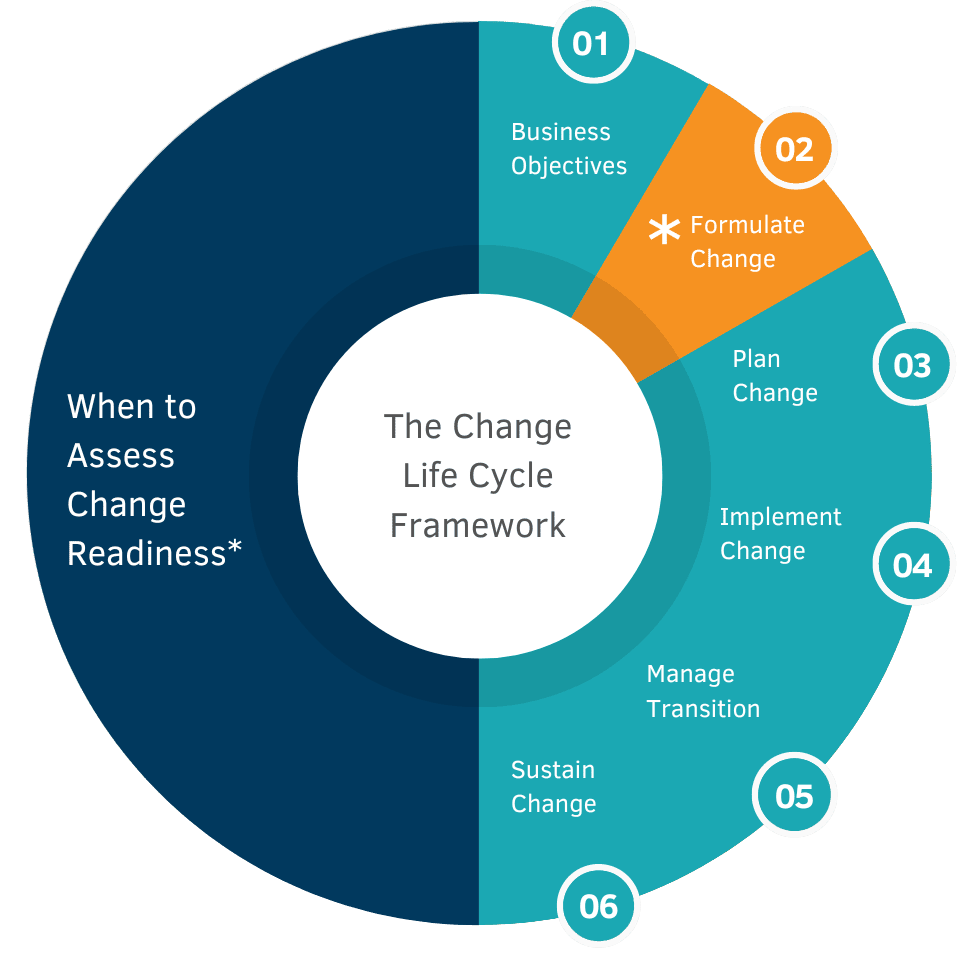
At Creative Analysis, we do offer a stand-alone readiness assessment. We offer this because it can be a powerful way to surface early insights and shape more successful outcomes. If you are formulating change – now is a great time to talk to us about a simple, human-centred readiness assessment to set your change up for success.
However, most organisations come to us when they are already at point four in the change lifecycle: implementation (see above). In response, we have embedded a readiness mindset into the way we work. It is integrated into every conversation, every mapping session, and every reflection point.
This means we:
- Stay alert to how change is landing in real time, not just how it was planned at the outset
- Identify signals of pressure, uncertainty, or misalignment, even when they are not spoken aloud
- Create space for clients to explore where support is needed without judgement or delay
- Offer flexible, people-first solutions that adapt to the reality of the work and the people doing it
We use tools like Miro, Zoom transcripts, collaborative documents, and informal feedback loops to understand what is happening beneath the surface. These are not add-ons or optional extras. They are part of how we ensure every change project we support has the best chance of success.
Readiness Is Not a One-Off
Conditions change. Priorities shift. People come and go. A team that was ready six weeks ago may be under pressure today. That is why we treat readiness as something to revisit throughout the life of a project, not something to tick off at the beginning.
This approach allows us to adapt early and support teams to stay on track, even when the unexpected occurs.

Juggling Change: What the Numbers Tell Us
If the experience of your team feels stretched, scattered, or unusually fatigued, the data suggests you are far from alone.
Today’s workplace is marked by relentless digital input, overlapping initiatives, and a constant cycle of change. Individually, each change may seem manageable. Collectively, they can become overwhelming – especially when layered on top of already demanding roles.
Recent research reveals:
- The average employee now navigates nine organisational changes per year, compared to just two before 2020.
- Chief executives are managing over three major change initiatives at the same time, each with organisation-wide implications.
- Across industries, 73% of employees say they feel overwhelmed by the volume of concurrent change.
- Only 38% feel confident in their ability to adapt to these changes.
- At the same time, the average company uses 129 digital applications, with individuals switching between platforms hundreds of times a day.
- Perhaps most striking, 38% of senior leaders say they would prefer to leave their organisation rather than lead another major change programme.
These figures are not intended to alarm – they are a reminder of the very human context in which change takes place. When we acknowledge this context with care and intention, we make space for change to succeed.

Final Thought
In most cases, it is not that teams are resistant to change. It is that they are already stretched and trying their best to keep pace. Our role is to recognise that reality, respond with empathy and insight, and support the conditions for change to take root.
Change deserves more than a launch. It deserves space to land.
If your team is motivated but running close to the edge, we would love to talk about what support looks like in practice, book a call with Creative Analysis today.

Blog Contributors: Paula Atherill, Director at Creative Analysis, brings over a decade of hands-on digital transformation experience. Her calm, structured approach helps change land in ways that are both practical and sustainable, supporting people and systems to move forward with confidence. Kristy Lake, Design Ops, brings strategic clarity and an evidence-based approach to change. Immersed in the R = MC² readiness formula developed by the Wandersman Center, she helps organisations understand where capacity, motivation, and context align and where thoughtful design can unlock progress.
References and Sources
- Okta – Business at Work Report 2023
The average company now uses 129 digital applications, with that figure rising to over 200 in large organisations. - Gartner – Change Readiness and Fatigue Research (2022)
Employees experienced an average of 10 planned organisational changes in 2022, compared to just 2 in 2016.
73% of employees reported feeling overwhelmed by the amount of change happening at once. - HR Executive Summary of Gartner Insight
Only 38% of employees feel confident in their ability to adapt to change. - The Times – Enterprise Network Reporting on Change Fatigue
Employees now experience an average of nine organisational changes per year.
Chief executives are managing an average of 3.2 major change initiatives at the same time.
38% of senior leaders would prefer to leave their organisation rather than lead another major change programme.